
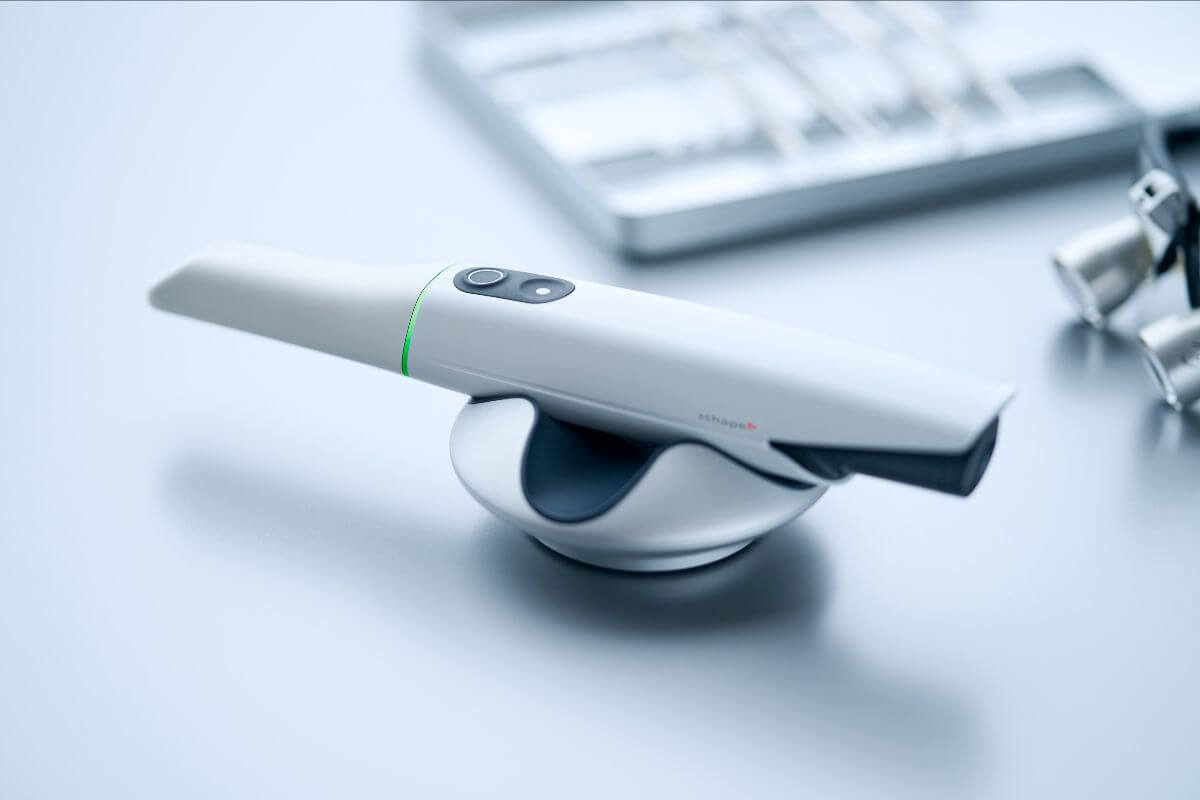
Intraoral scanners are a staple in most dental offices in 2025. They help speed up appointments, reduce the need for remakes, and make treatment planning a lot more predictable.
However, while many scanners look similar and claim to do the same job, they can differ quite a bit in comfort, accuracy, software, workflow, and long-term value.
If you’re comparing the Medit i700, TRIOS 3, and TRIOS 4, you’re looking at three highly capable devices, just in different ways. The right fit depends on what you expect from your scanner and how you want your practice to operate day to day.
Let’s take a closer look at how these three perform in the real world and what sets each one apart.
How Each Scanner Feels in the Hand
When you’re scanning multiple arches in a day, the weight and balance of the scanner can affect how smoothly the appointment goes, as well as how your hand feels at the end of the week.
Carpal tunnel syndrome is already common among dentists. Current data shows that 22.5% of dentists have CTS without noticeable symptoms, while 64.2% report mild symptoms. Using a heavy or awkward scanner can exacerbate the condition.
Medit i700
The i700 is the lightest option here, and you notice it right away. It’s easy to maneuver, especially during full-arch scans or when you’re working around tighter anatomy. The smaller tip also helps when scanning younger patients or anyone with a limited opening.
TRIOS 3
The TRIOS 3 may not be the lightest, but it’s well-balanced and easy to get used to. After a few cases, most clinicians find that it settles nicely into their workflow. The wand feels stable in the hand, and the design has been proven across years of daily use.
TRIOS 4
The TRIOS 4 has a slimmer wand, improved balance, and an overall more refined feel. If you scan a lot throughout the day, the little bit of extra comfort can go a long way.
Workflow and Speed in Daily Use
A scanner can look lightning fast when someone else is holding it in a staged demo, but the real test is whether it can keep up with you chairside. You don’t want to stop mid-scan because the software lags, freezes, or forces you to rescan half the arch.
Medit i700
The Medit i700 moves through full arches with surprising ease, even when you’re scanning quickly. It doesn’t choke on long stretches or complex anatomy, and the software does a good job stitching everything together. For the Medit i700 price, the performance punches above its weight class.
TRIOS 3
TRIOS 3 may not be the fastest scanner on the market, but it is consistent and dependable, which is important when you’re working through multiple cases in a row. Most users find it keeps up just fine, particularly for routine restorative work.
TRIOS 4
TRIOS 4 processes data faster and captures more detail in fewer passes. It also seems to recover more gracefully if the scan path breaks or needs to be reoriented.
Accuracy and Clinical Results
Accuracy is the backbone of any digital workflow. Your margins, contacts, and occlusion all depend on how faithfully the scanner captures what’s in the mouth. If the scan is off, even slightly, the final restoration will be too.
Medit i700
The Medit i700 produces clean, accurate files that most labs can work with without issues. For many general practices, the accuracy level is more than enough to deliver predictable, reliable results day after day.
TRIOS 3
TRIOS 3 has a stellar track record. Labs know what to expect from it, and the scans usually come in with well-defined margins and prep geometry. It’s a safe bet for consistent, high-quality results.
TRIOS 4
With TRIOS 4, the detail sharpens even more. You get stronger color capture, deeper data, and finer surface definition. These upgrades are highly appreciated in demanding situations, such as anterior ceramics, multi‑unit restorations, full‑arch work, or advanced implant planning.
Note that all three scanners meet clinical standards for accuracy. The difference is in how much they help you carry more complex cases across the finish line.
Software, Flexibility, and Ecosystem
A scanner is only as flexible as the software it runs on. Here’s how these three systems differ once you step into their ecosystems.
Medit i700
One of the biggest draws of the i700 is how open the workflow is. You can export scans in common formats like STL, PLY, or OBJ and send them to almost any lab or CAD system you prefer. There are no restrictive licenses or long-term subscription requirements.
The trade-off is that Medit doesn’t offer a complete in-house CAD suite. If you want to design restorations or handle advanced digital planning on your own, you’ll need to pair the scanner with software like Exocad or another third-party tool.
TRIOS 3 and 4
On the other side of the spectrum, the TRIOS 3 and TRIOS 4 operate within a more structured ecosystem. The software is polished, feature-rich, and tightly integrated. You get access to tools for ortho simulations, implant workflows, digital smile design, and patient communication inside one connected platform.
That said, the defined system may not appeal to practices that prefer open formats or want to mix and match different CAD tools.
Cost, Value, and Long-Term Fit
A scanner is an investment. But value doesn’t always mean the lowest price. It’s about how much long-term benefit you get from what you spend.
Medit i700
The Medit i700 price is hard to beat if you’re looking for a reliable, budget-friendly scanner without extra costs. It’s a great fit for practices getting into digital dentistry or anyone tired of dealing with ongoing subscription fees. It’s highly functional, flexible, and avoids the extra costs tied to closed ecosystems or subscriptions.
TRIOS 3
Moving up a tier, TRIOS 3 falls into a comfortable mid‑range price point. It does cost more than the i700, but that difference buys you access to a mature, well‑supported ecosystem that’s proven itself over many years. You get reliable accuracy, broad lab compatibility, and a workflow suitable for a wide range of case types.
TRIOS 4
The TRIOS 4 is the most expensive, but also the most refined. In exchange for its high price tag, it offers the most advanced tools, faster processing, and a more refined scan quality. Practices managing complex implant cases, aesthetic dentistry, or full-arch work typically find the upgrade worthwhile because of the clarity and efficiency it adds to their workflow.
Let Your Workflow Pick the Winner
Each of these scanners brings something different to the chair.
- The Medit i700 is efficient, budget-friendly, and gives you plenty of flexibility.
- The TRIOS 3 is steady, predictable, and trusted by thousands of practices and labs.
- The TRIOS 4 is the most refined and is meant to tackle advanced digital cases.
Still unsure? Ask yourself how many cases you’re scanning each day, what kind of procedures you’re doing, and whether you want a closed ecosystem or something more flexible.
Once you know the answers to those questions, the right scanner usually reveals itself quickly.
